
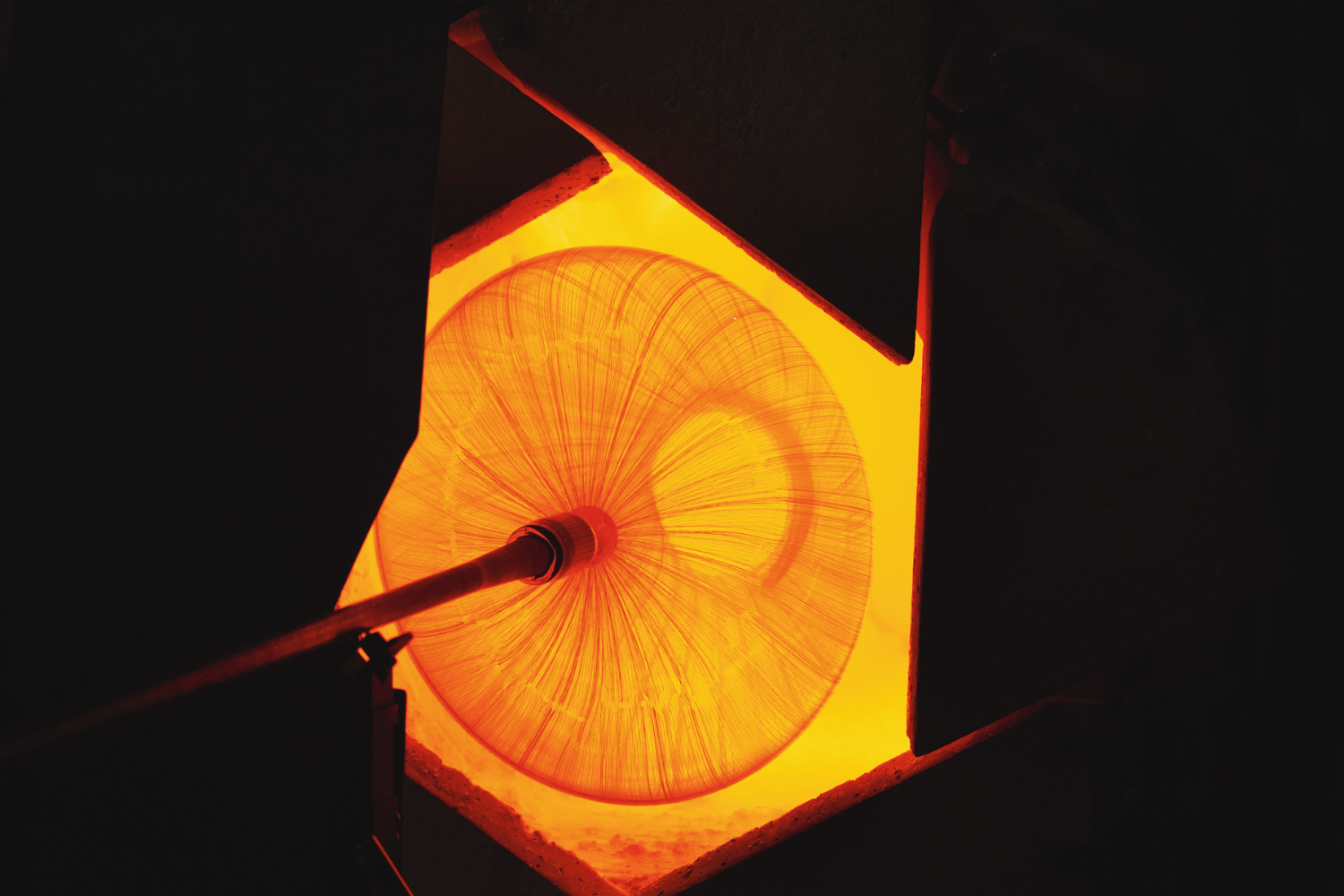


In 2015, Jeremy Maxwell Wintrebert opened his studio beneath the arches of the Viaduc des Arts, right in the heart of Paris’s 12th arrondissement. There, through his artistic exploration of molten and expanding glass, this Franco-American artist conceives and creates glass sculptures and installations—his vital medium—which are featured in various collections at international institutions such as the Victoria & Albert Museum in London, the Palais de Tokyo, and more recently, the Musverre.
Arthur Frydman : How did you discover the world of glass and, more specifically, the craft of glassblowing, driven by this desire to create?
Jeremy Maxwell Wintrebert: My first encounter with glass dates back to my childhood. It’s a cathartic memory that left a deep impression on me. I was four years old and playing with my brother when I stumbled upon a piece of broken glass on the floor. I cut my arm. I was fascinated by this material, which is so fragile and dangerous at the same time. After my A-levels, I went to the United States where I did a series of odd jobs.
I was lucky enough to meet a glass artist who invited me into his studio. I remember watching the furnaces, mesmerised by the molten glass. It was at that moment that I realised this material would define the rest of my life.

In 2019, you received the Liliane Bettencourt Prize for manual dexterity. Designer, artist, craftsman... How would you define your work?
J.M.W.: I am an artist and I have made glass my medium. I have mastered all the gestures and techniques of my art, which affords me great freedom.
What is your relationship with the material?
J.M.W.: I see glass as the epicentre of the material’s energy. I am captivated by this spellbinding light produced by an organic, transparent substance which, day after day, never ceases to fascinate me and remind me of my own limitations. It is a relationship, a mutual exchange. I shape it as much as it shapes me. Molten glass is a chaotic material; that is to say, the molecules within are in constant motion, and as they cool, they create a stable structure.
In glasswork, we move from chaos to something organised; it is the story of the universe, of life. Working in this way resonates with my personal history, where I blend chaos and creativity.
When you work with glass, does it speak to you?
J.M.W.: I have an intimate relationship with it. At every stage of my creative process, I ask it questions and spend my nights deciphering the answers. I am convinced of the existence of a consciousness within the material that predates my own existence, and this fascinates me. I am at the service of the material. It is a relationship between two beings, an existential quest that has driven me since childhood. As I often say, matter resembles what I feel.

Your artistic world is imbued with concepts such as time, space and the metaphysical universe. What are your sources of inspiration?
J.M.W.: My artistic journey is marked by a fundamental quest: the search for a reason to live, a vital force, an unalterable core of existence from which everyone can build and create themselves. This quest nourishes my work just as I am nourished by it, in a deep and constant exchange. It drives a journey rooted in an introspective dimension – that of my childhood in Africa – gradually evolving towards a form of externalisation. I have come to question the origin of these two sources of inspiration: the creation of the universe and of life.
Have certain artists inspired you in your vocation?
J.M.W.: Vincent van Gogh, who, through his obsession with gesture and material, managed to tell the story of light. James Turrell and Bob Marley for their strength, both rhythmic and tranquil. I also draw a great deal from the world of science: Étienne Klein and Stephen Hawking are figures who inspire me. Galileo too, who, using a thin sheet of glass magnified 20 times, managed to observe the lunar craters.

Your workshop, situated beneath the Viaduc des Arts in Paris, is right on the high street and must attract plenty of curious visitors. Does your craft—which is becoming increasingly rare and involves passing on ancestral know-how—inspire others to take it up?
J.M.W.: I opened my studio in 2015 to pass on this age-old craft, this tradition of glassblowing that constantly plays with the gravity, movement and temperature of the material. Any artist who respects their craft is obliged to pay tribute to the passing on of knowledge, as they exist solely thanks to a transmission of expertise that has spanned centuries, even millennia, wars, diseases and borders.
My plan is to set up further workshops to welcome other glassmakers specialising in glassblowing. It is a difficult craft that is becoming increasingly rare. As well as passing on the craft, I hope to help it grow once more.
Article written by Arthur Frydman, to be found in volume 3 of Oniriq Magazine
Translated by Bethszabee Garner


