

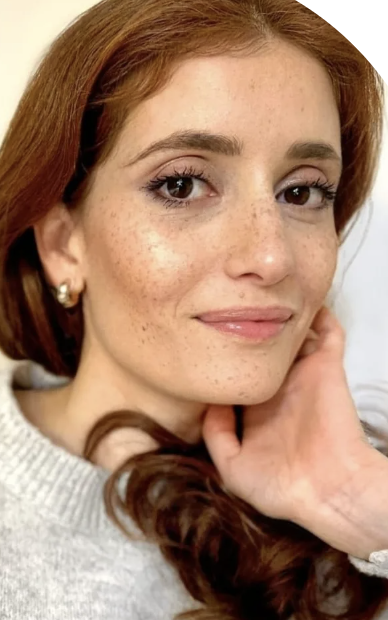
Interview with perfumer Louise Turner
Sirine Errammach: What is the scent that instantly takes you back to your childhood?
Louis Turner: The smell of freshly cut grass, fresh greenery – it brings to mind English gardens in summer.
The first perfume you ever wore?
L.T. : Fidji by Guy Laroche, a gift from my aunt when I was 10. But the first one I bought for myself at 16 was Givenchy Eau de Parfum, a green floral.
The scent you simply can’t do without?
L.T. : The scent of clean laundry dried in the sun, out in the open air.
The scent that inspires calm and serenity in you?
L.T. : A log fire reassures me and calms me instantly.
The scent that takes you on a journey?
L.T. : The scent of sun cream, and particularly that of Ambre Solaire. A promise of holidays, salt water and sunshine.
The scent of love?
L.T.: The scent of my daughter when she was little, a blend of musk and milk, a warm, rounded scent. Something that awakens an intense feeling of protection within me.

The unlikely scent you’d like to bottle?
L.T. : In perfumery, there’s no such thing as an unlikely scent; it’s all a matter of creativity and personal taste.
The fragrance that never leaves you?
L.T.: Although I’m very fickle when it comes to perfumes—as I often wear whatever I’m working on—I always come back to Mitsouko, by Guerlain.
The scent you hate the most?
L.T.: Costus, a raw material that smells of a wet dog – I can’t think of anything else! But even worse for me is the smell of andouillette!
What was your most recent olfactory experience?
L.T. : Smelling an original version of Tabac Blond whose scent had held up perfectly: a genuine journey back in time.
What is the starting point for your creations?
L.T.: It’s always very simple: either the translation of an idea using a few raw materials, or a scent in nature around which I want to build a story, like the one told with Atmah, my first creation for Caron. I always try to keep the simplicity of the original idea as I move forward with the construction of the fragrance.
What was the inspiration for Atmah?
L.T.: It’s the idea of a liberated vanilla, inspired by Olivia de Rothschild and her travels in Kyrgyzstan. My role was to transform these images (air, light, infinite horizons) into olfactory matter. I wanted this vanilla to breathe, to be alive, vibrant, and to convey that sensation of infinite space.
What is the key ingredient?
L.T.: There are two: Madagascar vanilla and a mineral accord composed of ambrox and akigalawood.
The aim was to reveal the depth of the vanilla without heaviness, its nobility without artifice, but also its intimate character, which is not geared towards seduction. Combined with woods and mineral notes, the vanilla takes on a different resonance; it becomes crystalline and ethereal. The mineral note does not express itself through a direct scent, but through a play of textures and contrasts that convey the sensation.
What was the main challenge in the formulation?
L.T.: Treating vanilla in a non-sweet way. I wanted to move away from the expected conventions. No sugar, no dark or heavy aspects. I sought out its purest, most mineral dimension, its textured and noble side, to liberate it, unfold it and let it breathe.
How do you feel when you smell one of your creations on someone?
L.T.: A fragrance comes to life when it is worn. This gives it depth and takes it out of the abstraction of its creation.
So it’s always a lovely encounter, and it’s also reassuring that my fragrance has been chosen to accompany someone’s life. The fragrance then becomes real. Atmah, for example, is worn by women but also by men. I love that freedom of choice.
An article written by Sirine Errammach. Read it in issue 14 of Oniriq Magazine.
Translated by Bethszabee Garner


