

Translated by Bethszabee Garner
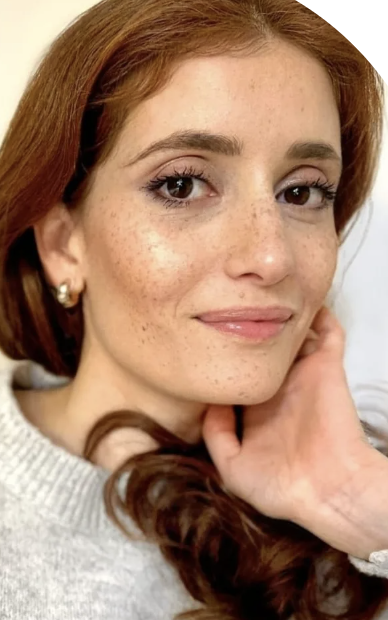
The first perfume she ever wore, the scent that makes her travel, the one she dreams of bottling... On the occasion of the launch of her latest creation titled Barénia, Christine Nagel, perfumer and Director of Creation and Olfactory Heritage at Hermès Parfums, shares with us her olfactory universe.
Sirine Errammach: What scent instantly takes you back to your childhood?
Christine Nagel: Borotalco, the baby powder from Italy. I remember my Italian mother putting it on my little brother. It’s one of the first smells I can recall. But the most interesting one remains the scent of my grandmother’s handbag when I opened it. It had a powdery, soft smell, deeply rooted in my memory. Powder was universally used by women at the time. When I arrived at Hermès, I discovered that this same story inspired the creation of Hermès’ very first women’s perfume, the legendary Eau d’Hermès, the scent of the inside of a woman’s bag.
Sirine Errammach: The first perfume you ever wore?
C.N.: Havoc by Mary Quant, created by Jean-Claude Ellena. A lovely coincidence, knowing that I succeeded him at Hermès as the company's in-house perfumer in 2014.
Sirine Errammach: The scent you can’t live without?
C.N.: The scent of my grandchildren’s skin. I even created a perfume inspired by it: Cabriole.
Sirine Errammach: The scent that inspires calm and serenity?
C.N.: The smell of my garden in Normandy.

Sirine Errammach: The scent that makes you travel?
C.N.: The sea.
Sirine Errammach: The scent of love?
C.N.: That of the man I love, that invisible imprint that overwhelms you with emotion, that moves you by its presence.
Sirine Errammach: The unlikely scent you would love to bottle?
C.N.: The very essence of the miraculous berry.
Sirine Errammach: The perfume you never go without?
C.N.: The perfume I’m currently working on, tomorrow’s or the day after’s.
Sirine Errammach: The scent you dislike the most?
C.N.: I don’t really have a smell I dislike, except maybe vomit.
Sirine Errammach: What is the starting point of your creations?
C.N.: The creation of a perfume results from an act of memory, an “archiving.” I am curious and sensitive, and every day brings its share of images, impressions, encounters, and moments that leave their mark. I store them in my memory, and they express themselves, or will do so, through perfume when the time is right. In any case, they constantly feed my imagination and my creative process. Today, I work for Hermès, a brand with an extraordinarily rich history and creative legacy. Its worlds are abundant; the sources of inspiration are right before my eyes, every day. I draw from and am nourished by the label, an inexhaustible well of inspiring stories for everyone.
Sirine Errammach: What do you feel when you smell one of your creations on someone?
C.N.: It deeply moves and delights me that a complete stranger is wearing a little piece of me.
Sirine Errammach: What was your last olfactory emotion?
C.N.: Discovering a roasted oak with a sensual scent reminiscent of rum.

Sirine Errammach: Last September, you unveiled a new creation for the label: Barénia. What inspired you to imagine this fragrance?
C.N.: It’s a beautiful story of a meeting between the Hermès woman and material, two worlds that echo one another. In both cases, it’s about sensuality, elegance, signature, and audacity. It took me time to get to know the Hermès woman, to understand her and internalize that very particular, very elegant sensuality.
Sirine Errammach: It is also the first Hermès chypre. Why was it important for you to explore this classic perfume family?
C.N.: The allure of a chypre matches its complexity, because it is not a single material but an archetype of perfumery, a combination of raw materials that create a particular style. A chypre is already, in itself, a creation, more or less structured in the same way: a fresh, citrusy top note; a floral heart, often rose or jasmine and quite opulent; followed by patchouli, cistus, and oak moss. You’ll notice that when a woman loves a chypre, she loves it for life and always returns to it. Fidelity to chypre, to its elegant sensuality, is neither reasonable nor rational, but rather instinctive.
Sirine Errammach: How does your interpretation of the chypre stand out?
C.N.: Even though I know the chypre structure well and have always cherished it, it had to be different and recognizable. Its structure is clear, but every raw material carries a surprise, that little side step so beloved by the brand. For the citrus top note, I chose a specially treated bergamot, very clear, crisp, and bright. Wanting a floral bouquet that was distinctive yet pure, I opted for the intoxicating Madagascar butterfly lily. Its fragrance is mysterious, both powerful and elegant. To emphasize the magnetic uniqueness of the composition, I chose roasted oakwood, with its warm and enveloping trail. As for patchouli, that woody, aromatic herb I adore, I stretched between the old-fashioned and the high-tech, composing with both traditional patchouli and a biotechnological one: Givaudan’s Akigalawood®. And finally, the miraculous berry, which brings Barénia its alluring, gentle note.
Voir cette publication sur Instagram
Sirine Errammach: How does Barénia reflect the essence of the Hermès woman, both through its composition and its bottle?
C.N.: The Hermès woman has this particular trait, she trusts her instinct; she is strong and free. Adventurous women such as Isabella Bird, Alexandra David-Néel, Charlotte Perriand, and of course Nancy Cunard inspired me. Their attitude and instinctive grace were masterful and strikingly modern. That instinctive rightness, that embodied freedom, I find them both in Hermès women and in Barénia: the sensual and elegant signature of an instinctive, captivating, unforgettable woman.
This perfume is also inseparable from the object that reveals it, an emblematic, talismanic object signed Hermès Paris. Philippe Mouquet set out to find an object capable of symbolizing this Hermès woman. He quickly thought of the collier de chien bracelet, that mythical accessory of the brand which has transcended time, ages, and eras without losing its edge. He succeeded in creating a powerful and sensitive object, with new curves that, I’m certain, will endure through time just like that iconic bracelet.
Article written by Sirine Errammach, featured in issue no. 9 of OniriQ magazine.


