

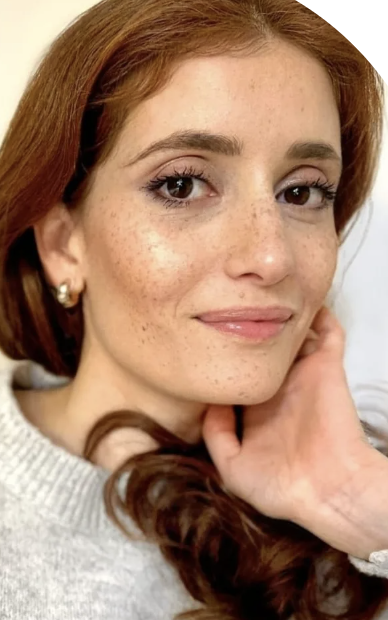
Sirine Errammach: What does iris evoke for you?
Dora Baghriche: Iris was my first love in perfume. Following family tradition, I was fond of colognes, which reflected my Mediterranean roots. Then one day, I smelled the perfume Iris by Hermès and discovered this ingredient. Iris evokes a particular emotion that speaks of the earth, time, fragility and absolute solidity. It's a paradox. There is something both primal and androgynous about iris that is unique. I really like its earthy facets, which bring me back to the essentials. It is not an easy ingredient to use in perfumery from an olfactory point of view, and at the same time, it is a scent that is so comforting.
Sirine Errammach: How did it become popular?
D.B.: Iris has been used since ancient times. The Romans flavoured their wine with it, and iris powder was essential in Chinese medicine for treating wounds. In the Middle Ages, this flower was very popular in Italy and became the emblem of the city of Florence. Its importance spread beyond Italy during the Renaissance thanks to Catherine de Medici, who helped popularise iris cultivation in France and encouraged its use in royal gardens and French perfumery.

Sirine Errammach: What are its olfactory characteristics?
D.B.: We often imagine that it is the beautiful blue flowers that are used in perfumery, when in fact it is the roots that reveal its precious notes. Iris has a primarily woody scent, slightly almondy and powdery, with hints of violet leaves. There is a note of carrot seed that I particularly appreciate. Iris also has a slightly spicy, almost angelic and balsamic dimension. It is sublime in itself and enhances the other ingredients in a fragrance. It brings a very particular texture and grain: buttery, floury, root-like and woody. It is instantly recognisable.
Sirine Errammach: Growing iris requires several years of patience. What are the different stages?
D.B.: It is a flower of patience that requires a long-term commitment, as it takes three years in the ground for the rhizomes (underground stems on which small roots called rootlets form) to reach maturity. Obtaining iris absolute requires real expertise. These years in the field are essential for the plant's fragrant components, the irones, to develop in its rhizome. Only after many years can the rhizome be dug up, cleaned, trimmed and finally sliced. This initial cleaning process is long and tedious, and is done by hand to avoid damaging the precious roots. Next, it is time to dry them to remove the water. This results in a loss of about 60% between the fresh and dry roots. After a week of drying in the sun, the roots are stored in jute bags for another three years. This is the time needed for them to develop irones, the molecules that determine the intensity of the floral and powdery profile. Finally, once dehydrated, the rock-hard rhizomes are ground into powder and steam distilled. The powder takes on a creamy consistency. This iris butter is extracted with solvents to produce iris absolute. It takes about three tonnes of fresh rhizomes and up to six years of patience to obtain a single kilo of absolute, which sells at a premium price of up to €100,000 per kilo!
Sirine Errammach: Where does the iris you use come from?
D.B.: Our sourcing teams have developed a supply chain in Tuscany, with magnificent quality and traditional craftsmanship. Iris pallida has been reintroduced in France in recent years, and dsm-Firmenich is working closely with farmers on the Valensole plateau and in the Grasse region to revive its cultivation in a sustainable way. This Provençal iris will soon be distilled in a dedicated still at our factory in Tourette, in the Var region. It is important for a perfumer to be able to use different sources of a raw material, as this brings nuance and richness to the compositions. I am delighted to soon be able to compose my creations with this French quality.

Sirine Errammach: What notes can iris be associated with?
D.B.: Iris is a base that supports many fragrant stories. It lends a noble character to more common raw materials. It allows me to do many things; I can create a white iris, combined with musk and rice tones. It blends with the skin with a modern sensuality. I can also explore green iris, combined with galbanum, vegetal and also racy with a timeless elegance. I like to combine iris with ambrette, carrot and violet leaf. There is a common thread in terms of scent: they are all root materials. They have something in common, so they complement each other.
Sirine Errammach: What considerations do you take into account when choosing iris for a fragrance creation?
D.B.: When I create around iris, I like to play it majestically in my compositions, in the most visible way possible. I love the smell of iris concrete so much that I could wear it on its own.
Sirine Errammach: Does it have as much of a place in men's fragrances?
D.B.: Iris is a timeless ingredient and has been used in many iconic men's fragrances. In Dior's Bois d'Argent, it brings a subtle sweetness and timeless elegance. Iris also blends very well with peppery notes, violet leaves and vetiver, as in Geoffrey Beene's Grey Flannel.
Sirine Errammach: What is your latest composition with iris?
D.B.: I recently signed for Chopard Iris Malika, a warm amber iris, a bold signature with balms. I have two very beautiful creations coming soon. A very beautiful iris with slightly green tones and a very sensual, warm iris surrounded by vanilla. Iris is eternal in perfumery and I still dream of telling new fragrant stories around this precious ingredient.
An article written by Sirine Errammach, featured in issue 7 of OniriQ magazine.
Translated by Bethszabee Garner


